You may be pleased - or maybe not - to know that my posts will again be getting more regular as I am now back home after my 'summer' sailing. I thought I might just give you one more blast of salt air by embedding a very short seafaring video here. It shows my boat Moonshadow rounding the notorious Mull of Galloway in SW Scotland. This headland can be a very nasty place to be in bad weather. On this trip there was little or no wind. Even so, the tide was whipping along and giving me a speed of 11.9 knots - that's a lot in a sailing boat.
The video was shot on my Canon G9 and, even considering the loss of quality of YouTube compression, it has done a pretty good job.
You will notice that some filming techniques are exactly the same as those used for stills photography. Towards the end, notice the slight lowering of the shooting angle in order to get a clearer view of the distant headland between the gear on the back of the boat. This is followed by zooming back to view the wider scene including the foreground - with stills photography, the shutter button would have been pressed to take a picture at each separate stage.
And for those of you who love shooting sunsets - the video finishes with a really spectacular one. We carried on sailing into the night.
16 Aug 2008
Video with Canon G9


10 Jul 2008
Photographing shadows

Include shadows in your photographs and can show graphically, or express more subtly, anything from lead-in lines, texture, atmosphere, angular or curvaceous shapes, narrative or mystery.
Shadows can be used as subjects by themselves, or as devices to add interest and leading lines within your composition. Take a look at the picture of the door knocker (below) for example; the shadow forms a major part of the composition. Without it the picture would be very ordinary; a simple record of an object. But the shadow of the brass knocker extends across a large part of the left side of the picture – it has been used not only to accentuate the shape of the knocker and the door nails, but as a compositional device.
Mystery? Well, yes, include only the shadows of people and this can inject a powerful feeling of something or someone unseen; a suggestion of what the person might look like, but without the whole subject revealed plainly. That in itself makes the viewer of your picture look again and try to see more. People are always curious about people so if they cannot see the full features of the subject they are left with their curiosity unsatisfied. This can create a visual puzzle without the answer – and that becomes intriguing.
So what about the practicalities of including shadows in your photographs? How do you arrive at the correct exposure, for instance? Well, I’ve never believed in making difficulties where there are none, and taking pictures of shadows is no exception. As a rough and ready guide, just remember that if you want your shadows to be darker, you should expose for the brighter areas in your picture. It’s as simple as that. But don’t overdo this or your pictures will be underexposed and have a lifeless appearance. The other thing to be aware of is that shadows can register as very high colour temperature – they appear blue – when they are cast by a bright sun in a clear blue sky. So you may want to try the ‘Cloudy’ White Balance (WB) setting to counteract this. But this will depend on the effect you are trying to achieve.
 For those of you who are a bit nervous about taking pictures of people, photographing other people’s shadows can come as quite a relief. You will no longer need to point your camera directly at your subject, who is likely to remain quite unaware of what you are doing. Pictures that include the shadows of people – without actually showing the people themselves, encourage the viewer of the photograph to interpret a story or narrative into the image. They must ask themselves what the people are doing, what they might be saying or discussing – and that’s when a sense of mystery can be intoduced into your photographs (see photograph at top).
 5 Jul 2008
Low ISO speed

I've just arrived back in my home port of Kirkcudbright aboard my boat Moonshadow. Almost the first thing I did was reach for my little Canon G9 and take a picture. It was late afternoon and the light had that special brilliance. It was shining full belt onto the scallop fishing boats standing high and dry in the mud alongside the harbour wall at low water. The resulting picture would have been better if the water had been totally smooth in order to give perfect reflections. Unfortunately there was just a hint of a breeze and this has ruffled the surface of the water a little, breaking the reflections.
But never mind, I like the deep colours that have been accentuated by the front light and the contrast of the greens, blue and rusty reds.
Like I've said before - boating and photography are the perfect combination.
I set the G9 on aperture priority at f7.1. This gave me a shutter speed of 1/200sec at ISO 80 - remember, it's always best to use the slowest ISO possible for best quality. There was plenty of light, so ISO 80 was ideal. I used centre-weighted metering mode. The exposure compensation was set to minus 1/3 and the white balance on AWB. I was zoomed in to give me an equivalent focal length of around 85mm.
10 Jun 2008
Using a monopod

Some time ago I was commissioned to photograph a lovely chap called Cedric Robinson, the official Queen’s Guide to the Kent Sands. A grand title for an important job. The Kent Sands are in Morecambe Bay in the NW of England, and some of you may remember that a few years ago over twenty cockle pickers were drowned in the bay when they were caught by the inrushing tide. It is a very dangerous, but hauntingly beautiful place. Quick sands abound and the going is treacherous underfoot – unless you know what you are doing - and Cedric certainly does.
He organises walks across the sands, and these have become hugely popular, attracting hundreds of people at a time. Obviously a magazine feature would have to include a picture of Cedric leading this multitude across the sands at low water. I envisaged a shot of him at the head of a column of followers – looking just like Moses.
Only one problem – the sands are almost completely flat, so getting an elevated position from which I would be able to see this line of people was not going to be easy. I couldn’t possibly carry a set of step ladders across the sands.
I solved the problem by mounting the camera on a monopod and using a long electrically operated shutter release. I was then able shove the whole assemble into the air above the heads of the crowd. This enabled me to get a picture of the whole long line of people with Cedric striding out at the front. Of course I could not see exactly where the picture was framed so I had to use a good dose of guesswork - and I was shooting film, so there was no way I could check the images as I went along and adjust the angles. But I took lots of pictures and was surprised when they were processed to find very few with completely wonkey horizons. Using a 24mm wide angle lens was a big help.
The biggest difficulty was holding the weight of the camera at the end of the pole, and trying to walk backwards at such a fast pace without falling over. I got the feeling that there were a few of those walkers who might have been waiting keenly for the photographer to make a complete prat of himself. They were out of luck. The picture was used across two pages in The Mail on Sunday Magazine and later in Saga Magazine along with many other pictures showing Cedric at work. That's Cedric in the centre of the picture above.
6 Jun 2008
Photography in mixed light

3 Jun 2008
photographing Scotland to Australia
 Here in Kirkcudbright early this year one of the students who joined us for a photography weekend was Tee Smith. Tee, who was then based in London, was keen to learn more about travel photography because he was about to set off on an epic trip to Australia via the trans-Siberian Express and Vietnam.
Tee was born in Thailand and educated in New Zealand, so his first trip to Scotland was quite an experience for him. Especially as his weekend here coincided with Burns Night. Now, I'm not a Scot, but there were plenty of Scottish photographers on the weekend who explained the mysteries of 'addressing the haggis' and the wonders of clewty dumplings. To his eternal credit, Tee tried and enjoyed all this wholesome Scottish food - as we all did. Well, you simply have to on Burns Night. I think Tee even tried a 'wee dram'.
 All was quiet from Tee until yesterday when I got an email from him to say he had finally arrived in Australia after a wonderful trip and after taking hundreds of photographs.
He sent me a link to some of them and it's well worth taking a look. There are some beautiful evocative photographs among the usual - and very important - fun travel pictures that can mean so much.
I have posted a couple of them here for you to enjoy, but do take a look at the others.
The middle picture is a poingnant shot of a woman placing a lighted candle on the memorial of the Jewish Ghetto in Warsaw - the scene of some of the worst German atrocities in WW2.
The lower picture shows the man himself - Tee tucking into a meal in Vietnam.
http://www.facebook.com/album.php?aid=37752&l=09634&id=705001595
Part 2:http://www.facebook.com/album.php?aid=37775&l=e034b&id=705001595
Part 3:http://www.facebook.com/album.php?aid=37780&l=dafc5&id=705001595
Part 4.
http://www.facebook.com/album.php?aid=37781&l=3cfe4&id=705001595

31 May 2008
How to see more photographs - video
Here is a very short video which I have produced as a bit of an experiment. If there is a positive response to this lively way of getting across information, I will maybe do some more. But we'll see how things go for now.
The idea is to show you what and how I am seeing things from behind the camera and how I think pictures through from the time I spot their potential to the time I press the button. So bear in mind that to do this, the movie camera is on the move and not stationery on a tripod - you are seeing what I am seeing. The aim is to help you see more photographs everywhere.
Of course this could have great potential for the way I post on the blog. Let's see.
Just click the arrow in the middle of the frame below to see this 3 minute clip.
25 May 2008
Timing your photographs - 2

Following on from my previous post about the importance of good timing when taking your photographs, here are a couple of pictures that illustrate another aspect of timing.
Good timing is not only vital in order to capture the precise moment the action is most interesting, but it can also have a profound affect on the composition and atmosphere of the picture.
Compare the two photographs taken of racehorses exercising in the Staffordshire countryside very early one winter’s morning. I was delighted to capture the shot of the horses though the trees and against such strong backlighting. The bare trees, the snow on the ground – everything adds to the atmosphere of that winter morning. The horses are walking quite slowly, not galloping, but still the timing is important. In the photograph above, there are more horses than in the shot below, but less is often more in photography, and by waiting until some of the horses had passed out of shot to my left, the composition became cleaner, and because of that the second photograph, below, has more impact.
Also, the silhouettes of the horses to the right of the first picture (above) are not ‘clean’; they are partly obscured by the trees. This has created a degree of confusion and has become distracting. By waiting until fewer horses can be seen more ‘cleanly’ between the trees in the second shot (below), the visual appeal has been heightened rather than reduced.
After taking the first shot, I did not give way to the temptation to follow the horses in the viewfinder in order to make sure I got them all in as they moved to my left, but, as you can see from the foreground, which has hardly changed, I simply waited until some horses moved out of shot and kept the framing almost identical.

22 May 2008
Timing your photographs - 1

10 May 2008
Photographing close-ups

Without any question, Rosemary’s amazing abstract image of jelly fish, below, demonstrates that you do not need top-range SLR cameras to produce great pictures. Rosemary was using a Fuji FinePix bridge camera – and an old one at that. This photograph also shows that great pictures are there to be seen in the most unlikely places, and of the most unlikely subjects – if you LOOK. I like to call this ability to see pictures almost everywhere as ‘visual agility’ You can all do it if you try.
 Ande’s two close-ups were taken on a Canon 400D. I confess I have looked at that loading mechanism on the big Vickers gun and never actually spotted its visual potential. Ande did – and a great picture is the result.
Okay, his picture of the door latch is a little more obvious and I would like to think that any photographer worth his salt would have spotted it too. But the fact is Ande not only spotted the picture but he made a cracking good job of capturing it in his camera; it i technically perfect and visually appealing.

7 May 2008
Photographing strangers
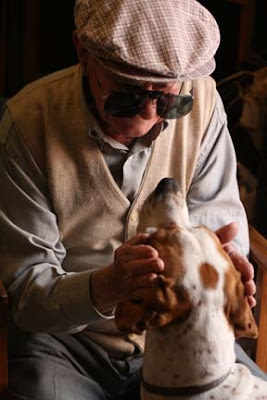
One of the places we sometimes visit is an old shop that sells everything from guns to leather saddles, wicker baskets and wooden mouse traps. It’s a marvellous place to take photographs and we are always made extremely welcome by Lorenzo, the owner, and Paca, his assistant. It's one of those real old-fashioned shops where people come in not just to buy, but also for a chat and a sit down. Lorenzo’s beautiful dog befriends everyone and is always a favourite subject for us. But when the customers sit by the door and talk to the dog – the photographers are in heaven.
When the charming old chap, photographed above, came into the shop, I simply asked him to sit by the door in the soft sidelight and let the photographers get on with it. I believe these situations are for them, not for me, so I always step back and let them move in to get their pictures.
This lovely photograph was done by Laura, who prefers to be called Beannie for some reason. She is very inexperienced behind a camera but possesses the ‘eye’. That is she has a natural flare for a picture. Here is the evidence. I think is absolutely beautiful; full of human tenderness. It has captured a very special moment.
I suggested that everyone set their ISO to at least 400 before they went into the shop – it’s pretty dark in there and it’s impossible to set up tripods. So that extra speed enables faster shutter speeds. Here it has really paid off.
Well done, Beannie. That’s her in the centre of the picture of three of the girls on the holiday. Oh, and below is a shot of Cathy making friends with another dog outside the shop while being photographed by the other Laura on the holiday.


19 Apr 2008
FTP for photo blog
Well, we've tried hard to get my blog hosted on my Photoactive website, but, for now, we have had to admit defeat and revert to the way things were. The problem we are convinced from reading the posts on blogger forums lies squarely with Blogger's poor FTP facility.
If anyone with knowledge of hosting a blog on their own website is reading this, I'd appreciate your comments.
We will keep trying and I'll keep you posted.
Thanks for your patience,
Philip Dun
12 Mar 2008
Photographing wildlife

7 Mar 2008
Photoactive Photographer's group
 Photograph by Paul Lipman
I am proud of the fact that some of my former students started a discussion group through which they share pictures and information. The group's first photo project has been completed and yesterday I had the job of commenting and 'critting' the pictures and of choosing my favourite picture. This was not a competition, just a project aimed at getting everyone out there taking more photographs. It is open to all levels.
I have to say the results were fantastic, and I have posted my personal favourite here. This doesn't mean it is the best photograph, just the one I connect to most of all. It was taken by Paul Lipman, who has been to me here in Scotland for tuition and also been on one of my holidays in Menorca. Paul has a natural talent and all I can say about this picture is - I wish I had taken it myself. It's a cracker.
This morning Paul emailed me to say:
"I was thinking of you when I took the man and dog picture!
You mentioned in one of your blogs(hate that term!) how you saw a man walking down the road and arranged to be at the point where he came upto a green door. I did the same thing with the entrance to the rear of the old building."
Well that does my heart good, Paul. It's always great to know when the teaching pays off.
Well done Paul and all the rest of the group. Great stuff. I'm looking forward to seeing the results of the next project - but it will now be Paul's job to decide what that will be.
If you would like to join in with the group, you'll find it at http://groups.yahoo.com/group/photoactive_photographers/
You will be given a very warm welcome.