Showing posts with label street photography. Show all posts

9 May 2008

Disgusting photography


I got an email from a reader about the picture of the naked man I posted yesterday. I thought I should share it with you….

Dear Mr. Dunn,
As a long time supporter of Photoactive and its activities, I have to complain most bitterly about the appalling lapse in good taste recently demonstrated in your blog.
A man's bottom indeed!
I am absolutely horrified!
Disgusted of Sevenoaks

Ah well, Disgusted, all I can say is that you would be even more horrified if you knew what an elegant, beautiful and seemingly pure-minded lady took the photograph of the man’s bottom. But my lips are sealed.

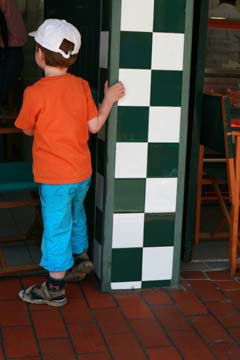
To more respectable photographic matters, here are some more people photographs taken by members of my group in Menorca over the last week. The shot of the little boy in the market, and the one of the lady in the apron, were taken by group member Laura during an excursion to the old town of Cuidetella. She was using a Canon 400D with a small telephoto. I love both photographs. The colour combinations and sense of animation in both pictures really brings them to life.
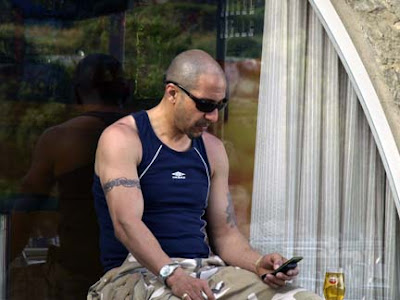
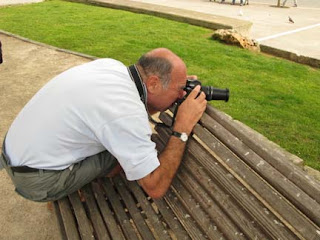
I also like Peter’s picture of the tough guy with the tattoos. Peter is getting so much reward from his photography, and it is a real delight to watch him improving every time we go out to take pictures together. That’s him taking candid shots from the cover of a bench in one of the squares in Mahon, the island’s capital city.

Oh dear, I’ve just realised – it’s another picture of a bloke. I’m going to have disgusted writing to complain again.
16 Apr 2008

Street photography - singing dog


While sorting and cataloguing hundreds of old photographs - that's my absorbing task right now - I came across this picture taken in Donegal, Ireland some time ago and just thought I'd like to share it with you.


This wonderful character was sat on the pavement outside a pub in the late afternoon. He had obviously enjoyed a good lunch and was a happy man. In fact he was singing. I think his dog might also have enjoyed a good lunch because it, too, was singing. Well, howling. The louder the man sang, the louder the dog howled.

What a great chap. What a face - what a row. What a wonderful opportunity for a photograph.


7 Mar 2008

Photoactive Photographer's group

Photograph by Paul Lipman


I am proud of the fact that some of my former students started a discussion group through which they share pictures and information. The group's first photo project has been completed and yesterday I had the job of commenting and 'critting' the pictures and of choosing my favourite picture. This was not a competition, just a project aimed at getting everyone out there taking more photographs. It is open to all levels.

I have to say the results were fantastic, and I have posted my personal favourite here. This doesn't mean it is the best photograph, just the one I connect to most of all. It was taken by Paul Lipman, who has been to me here in Scotland for tuition and also been on one of my holidays in Menorca. Paul has a natural talent and all I can say about this picture is - I wish I had taken it myself. It's a cracker.

This morning Paul emailed me to say:

"I was thinking of you when I took the man and dog picture!
You mentioned in one of your blogs(hate that term!) how you saw a man walking down the road and arranged to be at the point where he came upto a green door. I did the same thing with the entrance to the rear of the old building."

Well that does my heart good, Paul. It's always great to know when the teaching pays off.

Well done Paul and all the rest of the group. Great stuff. I'm looking forward to seeing the results of the next project - but it will now be Paul's job to decide what that will be.


If you would like to join in with the group, you'll find it at http://groups.yahoo.com/group/photoactive_photographers/

You will be given a very warm welcome.

18 Feb 2008

How to use a telephoto lens

Here is another simple example of using a small telephoto lens - in the case a 135mm equivalent - to capture candid pictures of people. I've had some photographers take me to task for daring to use a telephoto for 'street' photography. These purists believe it is only possible to take real 'street' pictures if a lens of 35-50mm is used. They are talking twaddle.
Perhaps they are secretly obsessed by the notion that they are following the example of Henri Cartier-Bresson who, they believe, was able to make himself invisible, get in close to all his subjects without being seen, and capture them all on a Leica with just a 35mm lens.
The story goes that the 'great' Cartier-Bresson tried this method while covering Winston Churchill's funeral for The Sunday Times. Apparently he did not produce a single photograph worth printing.
A small telephoto can actually add a lot to the 'feel' of a candid photograph by throwing the background slightly out of focus and isolating the most important elements of the picture. This frees the viewer's eye to concentrate on what really matters in the picture.
Of course it also gives the photographer the added advantage of remaining just that little bit less obvious.

7 Feb 2008

Street photography - perspective


Having said quite a lot about photographing people and what a powerful device it can be to have your subjects making eye contact with the camera, here’s a photograph that goes entirely in a different direction.

The strength of this picture comes from a dynamic feeling of depth and movement going right into the heart of the composition. Every line of linear perspective and every human action leads the eye forward, and yet it has to come back to look again at the straining figure behind the cart.

It is another photograph from my visit to China some years ago. I suspect all those people cycling to work will not be driving cars.

5 Feb 2008

Photographing people in the street - eye contact


This picture was taken in China – one of the few places in the world to which I have no desire to return. As you can see, the street performing sword swallower is the main subject. He has his eye glued on me and is trying to draw me into his act. Maybe he wanted me to try swallowing a sword. Whatever it was he failed. Simply because I kept my eye to the viewfinder and just kept on taking photographs. Eventually, he gave up on me and got on with trying to impress his audience by stuffing an assortment of swords and knives down his throat. I just carried on taking photographs.

One of the strengths of this photograph is a composition that gives a strong sense of depth – this is partially due to the use of a wide-angle lens, but mostly because of the differing scale of the figures from foreground to background.

Another forceful aspect of this photograph is the eye contact of the main subject, and, if you look to the left, the eye contact of the man who is watching for my reactions. Eye contact is a powerful device and can give the viewer of your photographs a feeling of involvement with the scene and the subject. It confirms that the subject is aware of the camera’s presence – in this case the subject is actually responding to the camera – there is a shared interaction.

3 Feb 2008

Photographing people - smile

Cathy has posted a comment about my post ‘Photographing people – TEN TIPS’. Part of her comment reads…

I've been reading more about street photography on various websites, and the range of advice and techniques on offer seems endless! One site offers advice on what to do when spotted which runs directly counter to your advice, Philip, and which makes me feel quite uncomfortable. http://candids.hervard.net/tips

Well, Cathy, I’ve just taken a look at that site and I have to say I am not in the least impressed by what I see. These pictures remind me of a list. They are mostly just visual records of people. Yes, there are a few interesting expressions – but then there would have to be when you consider how many pictures there are. What are these pictures of people for? I can see very little in the way of composition – most are simply cropped tightly around each subject. I might be missing something here, but, no, I don’t think so. These really are just records of what these people look like

It is not what I like to think of as street photography. I fail to see the visual appeal or merit. No story, no event or interesting moment captured – just records. Why?

I have no doubt that this photographer gets a great deal of pleasure from his photography, good luck to him. But it is definitely not a style I would want to copy. I am convinced that this method of sideways glances and detachment would have got me into a lot of trouble in many of the sensitive situations in which I have been involved around the world.

I am always telling my students that the camera belongs to the eye when they are photographing people in the street – and to press the button again when they are spotted. Then damned well smile!!! Look happy. Talk to people. Make contact. Be human, Do it all from behind the camera if you wish – it can lead to some great photographs and open all sorts of doors.

To illustrate just one situation like this, I have posted a couple of photographs. In the top picture, the main subject had no idea he was being photographed – yet almost everyone else around him could see what was happening. I even mimed to them, by smiling and putting my finger over my lips, to keep quiet and not let him know I was taking his photograph – they shared the joke. Of course it was not long before the man heard my shutter behind him – I was using a 24mm lens so I was very close. When he turned round his face bloke into a big smile – and everyone else joined the fun. I pressed the button again. That for me made a worthwhile photograph with a visual story to tell.

I’ll give you a few more examples of this technique soon.

1 Feb 2008

Canon G9 and Olympus XA

My criticism of the Canon G9’s poor optical viewfinder prompted happy recollections of one of my old cameras from the late 1970s. I still have it – a tiny Olympus XA. What a joy that little camera was to use. Without its detachable A11 flash, it fits beautifully into the palm of my hand – and it’s viewfinder, well… bright, wide and clear. This Olympus was revolutionary in its time. It has Aperture Priority only, with the shutter speed the camera selected displayed in the viewfinder by a lovely big analogue pointer.

Of course, unlike the modern digital compacts, you are able to stop the f2.8 lens right down to f22 if you wish. However, the fastest shutter speed was 1/500sec.

None of your fancy auto focus, either. Split-image focusing is by a silken-smooth sliding tab or knurled ring beneath the lens. Long before ‘ergonomics’ was a selling point, the focusing lever fell perfectly to hand. The slide-to-close casing was all but bullet-proof and the optics were wonderfully sharp. Oh, and the shutter was fired by a feather-light touch.

That little camera travelled countless thousands of miles in my pocket and it produced thousands of pictures that were published in newspapers and magazines all over the world. But one of my favourites was taken much closer to home. In Blackpool, Lancashire here in UK. This shot appeared in my first book way back in 1986. The original negative has had a pretty hard time over the years and the scan needs a lot of cleaning up now – so don’t look too closely - it is, though, needle sharp.

Know I know I’m getting all nostagic, but I reckon if Canon really want to produce a compact camera that is useable for street photography – they should take a very close look at that old Olympus XA – in particlular they should put their eyes – and I don’t mean the blind ones – to that wonderful optical viewfinder.

There is a fascinating original review of the Olympus XA here… Canon people please take a look.

http://www.urban75.org/photos/olympus-xa.html

Pictures show the Olympus XA with and without its detachable A11 flash gun

And in case you are wondering, no, I do not want to go back to the days of film - I love digital and all it can do... but I would like a small compact digital camera that I can put to my eye and see through properly. I want to be able to see what's going on through there, compose a photograph and time the action perfectly. Is that a lot to ask?

26 Jan 2008

Photographers' rights

There is a very interesting thread running on one of the photography forums right now about the legal rights of photographers, and how they affect you taking photographs in the street.

I have already made my thoughts very clear about the freedom of photographers to take photographs what they wish in a public place. However, there is a link on this thread that UK photographers might find very useful. It is to a downloadable pdf file setting out the legal position. It was written in 2004 and is due for an update so bear that in mind.

http://www.sirimo.co.uk/ukpr.php/2004/11/19/uk_photographers_rights_guide

That forum group is something very special to me. I did not start it and do not have any say in the running of it. It was started by a group of my former students and is going from strength to strength. There is a great deal of sharing of information.

I know that the moderator, Maria, would make you most welcome if you wanted to join and I’m convinced you will enjoy the fun company.
Go take a look…

http://tech.groups.yahoo.com/group/photoactive_photographers

I’m running one of my Photography Weekends here in Kirkcudbright this weekend so my time to post on the blog is pretty limited. I’m working with a great group of photographers and everyone seems to be enjoying themselves – keep you fingers cross for us tomorrow – we need some good light and weather.

25 Jan 2008

Photographing people - TEN TIPS

Questions, questions
My students ask all these questions when I suggest we go out and take pictures of people in the street. Some have to make a great effort to pluck up enough courage just to take the camera of the bag. Usually it does not take them long to see how much fun it is and how good the rapport can be with total strangers.

Here are five questions I am asked most often...

Q
Will people object to being photographed?
A
Well, I suppose you can make a friend or a foe in 1/500sec, but mostly people will either ignore you altogether, or ask why you are taking their picture. A perfectly reasonable question that deserves an answer. The amateur photographer has got the ideal reply – “I’m just a keen photographer who enjoys photographing people, I hope you don’t mind.”

Q
Will they become aggressive?
A
Very, very rarely. Common sense and basic street craft comes into play here and you will soon learn when to leave the camera in the bag. If someone tells you to ‘go away’, just smile and go, don’t argue, there are plenty of other subjects to choose from.

Q
Should you ask permission first?
A
I nearly always prefer to get something in the can and ask permission afterwards. Again, much depends on the circumstances, but remember, when someone says they don’t mind being photographed, you might have a ‘tame’ subject and you should ask to take more pictures.

Q
What should you do if they spot you taking their picture?
A
Take another picture – often the reaction to being photographed can create a very special photograph. Then smile broadly, hold both hands up and tell them what you are doing and why.

Q
May I publish a photograph I've taken of someone in the street?
A
Yes. Provided the photograph is not detrimental in any way to the person's character of good name. If you use the photograph for advertising purposes, that person may have a legitimate complaint.


TEN TIPS
Use fast shutter speeds to freeze people’s movements. 1/250sec minimum if possible. This may require a faster ISO such as 400 or 800 in poor light conditions.

Keep your camera set for instant use either with the correct exposure on Manual mode, or use TV (shutter priority mode). And keep your camera accessible – preferably around your neck and perhaps tucked into your jacket.

Be patient. Be observant and watch people closely.

Be aware of everything going on around you.

Anticipate where people are likely to go – you will learn to predict their movements quite well with practise.

Find good viewpoints and wait for people to move into them.

Start with ‘back view’ shots of people.

Take lots of pictures. That ‘decisive moment’ can be elusive.

Travel light – big, heavy camera bags are a nuisance and will attract attention.

Keep your camera bag zipped up when working in a crowded street. It would be a shame to lose equipment to light fingers while you are concentrating on taking pictures.

Top photograph
Once you have got more used to being seen about in the street with your cameras you can really start to enjoy yourself. You will find subjects everywhere. You must always be aware of what is going on around you all the time. Keep your eyes open and be prepared to move quickly into the best position when you see an interesting situation developing. Sometimes the subjects come right up to you. In this case, the two butchers were carrying their wares down a Dublin street. With the exposure already set and using a wide angle lens, all I had to do was wait until they filled the frame and press the button

Middle photograph
Towns like Cambridge are well used to people taking pictures, and chances are that you will be totally ignored when you raise the camera to your eye in a town like this. Don’t be in too much of a rush to take dramatic ‘candid’ shots of people straight away. Take it easy and slowly and concentrate on taking pictures of people who are absorbed in something else

Bottom photograph
No photographer worth his salt is going to walk away from an opportunity like this. Just keep pressing the button. With lively subjects it is always best to take lots of pictures. There is no need to interfere with what is going on – the kids are having a ball. The most important thing was to avoid a soaking from the little beggars

24 Jan 2008

Photographing people in the street - part 1

The most easily accessible location for photography is right outside your own front door – in the street if you happen to live in town. Out there people are coming and going about there daily lives, and the houses, buildings and surroundings themselves can make really worthwhile subjects. Yet so many photographers get into a sweat at the very thought of taking pictures in the street. Quite understandably, they feel self-conscious and a bit nervous about pointing their cameras at perfect strangers. This is normal, and if you feel that way, you are not alone. You probably also feel as if you are being intrusive. Well, in a way, you are and because this type of photography brings you into contact with total strangers it does not suit everyone. However, you don’t always have to tackle your subjects head-on - there are many more subtle ways of capturing pictures of people than simply sticking a camera in their face

The first and most important thing to remember is that you have a perfect right to take photographs in a public street. It is a right you should use.

It can help if you start by taking photographs of public street events or parades, where everyone participating and watching will expect lots of photographs to be taken and will readily accept the presence of photographers. A good training ground can be a busy tourist town – again, people will be expecting photographers to take pictures. You could try back views of people to begin with so that they may not even know they have been photographed and will not question you. All this will help you gain confidence.

Eventually someone will turn round and see you taking their photograph. Rule Number One – press the button again, smile broadly and say something pleasant. Tell them what a great picture they have helped to create, how good they looked and how you could not resist taking it. Laugh – be happy! Go forward and show them the picture on the preview screen if they are interested. Let’s face it, you would not have taken the person’s picture in the first place if you felt the subject looked at all threatening, so who knows, you may gain a friend, or a least a ‘tame’ subject who you may be able to ask to ‘do it again’. This approach can lead to countless happy encounters with strangers and many great pictures. Just don’t expect to be an expert overnight, it takes time to build technique and confidence – especially confidence.

Man on ladder
Gain confidence by photographing people without them knowing – call these candid shots if you wish. If subjects have their backs to you, then you can shoot away to your heart’s content. This chap had no idea he was being photographed – nor could he see those jackdaws above his head on the roof. They really helped make the picture

Top photograph
You can progress from shots of people’s backs to full frontals quite easily. Use a medium telephoto lens – the equivalent of a 180mm is fine. Once again compose your picture carefully without people in it. Get everything set then simply wait until a likely subject strolls along and press the button. Minimum 1/250sec to stop the subject and reduce camera shake. You can assess your potential subjects well in advance and if you don’t like the look them just wait for another one

Bottom photograph
You need a clear view of a busy gateway or entrance for this exercise; somewhere people will have no choice but to walk through the gap. Find a good out-of-the-way spot overlooking the spot and get comfortable; a bench where you can sit down is ideal, or stand in the shadow of an alleyway where you are unlikely to be noticed. Don’t rush. Take your time framing and composing your shot. Set the exposure. Now everything is ready and your trap is set. All you have to do is wait for the right person to walk into shot and press the button at the right moment – you have taken your first candid shot and the person you photographed knew nothing about it

Tomorrow I’ll give you a list of TIPS and answer some FAQs about street photography

23 Jan 2008

Photographing people - inhibitions

Self-consciousness is probably the main reason for holding back the talents of so many photographers. The thought of taking out a camera in public and pointing it at another person fills most photographers with dread. Why?

Maybe I was lucky to have had every inhibition knocked out of me at a very early age when I was an apprentice on a local newspaper. Even at the age of 15 I was expected to stand in front of a crowd of people and organise them into a group photograph – all this while using a 5 x 4 glass plate press camera and a flash unit with wet cell batteries I could barely lift. The first time I did this ‘solo’ was at a Christmas Fair in a school hall. The highest vantage point was the stage, and beneath the stage was laid out a table full of cakes and goodies. My boss, the chief photographer, stood at the back of the hall watching my performance.

In a voice barely broken by puberty, I yelled for attention and got a group of people herded near to me so that I could look down on them from the stage. You must bare in mind that in those days, the mantra of a local newspaper was ‘faces sell papers’. In other words, the more people you get on the photograph, the more newspapers will sell. I had gathered together perhaps 40 faces.

The very edge of the stage had a lethal sloping edge. You guessed it – just as I got everything set I slipped down the edge and skidded onto the table below. I watched my boss cover his face in shame as I waded ankle-deep in cream cakes and blancmange. However, the results of this spectacular fete of ineptitude was that everyone laughed – and I got the happiest photograph ever used in the newspaper.

Since that day I realised that it doesn’t matter a tinker’s cuss what people think of you at the time – provided you get the picture that matters. In actual fact all the ladies in the group rushed to offer me their motherly care – once they had stopped laughing.

---

Viv asks do I think black and white works best for people photographs, or is it my newspaper background? Well, Viv, a bit of both really. I love black and white. It has a power that colour can never quite equal. I do happen to have a library of b/w negatives numbering around 150,000, so I have plenty to go at. But that doesn’t mean I don’t enjoy shooting colour. Just to prove it I have posted a couple of colour ‘people’ pictures.

The shot of the couple lying on the beach was taken with their consent. I saw them from some distance and took the first picture with a short telephoto lens, but I wanted to get right in close with a wide angle. The camera was glued to my eye as a walked carefully forward and spoke to them – ‘You look absolutely wonderful, please don’t move and let me take a photograph’. I was actually taking photographs as I spoke. They were a lovely, happy couple and delighted with the result when I showed them the picture.

So throw aside those inhibitions and take more photographs.

I’ve posted the photograph of the farmer to show that I’m quite happy to shoot colour for street portraits.

22 Jan 2008

Photographing people in the street


I read on one of the photography forums recently a claim from a photographer who stated that true ‘street’ photography should not be done with a telephoto lens. It should only be done with a lens with an equivalent focal length of between 35-50mm. This is utter nonsense.

The correct lens for photographing people in the street is the lens that enables you to get the picture you want, and a photographer who hog-ties himself to this sort of narrow-minded work practice will miss an awful lot of worthwhile photographs.

I do not have a favourite lens for my street photography. I am just as likely to use a 24mm wide angle or a 180mm telephoto – rarely anything longer purely because of the inconvenience of carrying large lenses about. Quite apart from its effect of isolating your subject with its limited depth of field – as in the photograph above - a small telephoto sometimes enables you to remain just that little bit less conspicuous. I am perfectly happy to move in very close with my wide angle when I feel the picture needs that sort of approach.

When GlenF commented that photographing people in less-developed countries is still a delight, I have to agree. I’m not sure I agree that people in Western countries are more suspicious, though – perhaps they are just less civilised. I’m sure someone will correct me if I’m wrong, but when Mahatma Ghandi was asked what he thought of Western civilisation, he answered, “I think it will be good when they get it”.

Thanks to Saw Lady for her comment about paying street performers when you want to photograph them. I’d love to come over to NY to photograph you at work, and I think your blog is great. I suspect you get an awful lot of snappers photographing you already.
www.sawlady.com/blog

20 Jan 2008

Photographing people - do you pay?


Continuing my idea of showing you some of my pictures taken in India, here is one I took on a railway station platform.

I have quite deliberately included the figures sat on either side of the main subject. Without them the picture loses a great deal of its sense of place and context. I particularly like the large cosh the sleeping man has placed so conveniently to hand.

GlenF asks about street photography: "How about paying people on the street?" Well, the smart answer is - 'it all depends on the circimstances'. If your subject is a street performer or artist, then you must pay something. That's fair. So drop something into his hat or tin before you start taking photographs - and make sure the performer sees you do it. I very, very rarely pay - unless I really do want a picture of the person - and then I'm damned sure to get my money's worth.

I can not tell you how to blend into the background and yet still capture the things that happen around you. This is just something you must learn for yourself by actually doing it - or observe a professional as he works the streets. It's a lot about body language and the way you move around. It's about the way you look or don't look at people and the way you seek or avoid eye contact before and after you take your photographs. That's what my students learn from me on those holidays I run in Menorca when we cover Travel Photography.
http://www.photoactive.co.uk/menorca/menorca01.htm

7 Jan 2008

Photographing wildlife


Wildlife photography is a subject that has always interested me, but somehow I have never had the time to learn enough about it. Mostly because I have been too busy earning my living in other branches of photography - in the newspaper, magazine and commercial worlds.

To succeed professionally in wildlife photography you must be not only knowledgeable about your chosen subjects and their habits and habitats, you must also be totally committed. That can often mean sitting huddled up in a hide for hours, sometimes days, or even weeks at a time in order to get that unique shot. Very few photographers possess that level of patience – and I am certainly not among them.

There is, however, an aspect of wildlife photography that is still open to photographers like me. It’s a bit like street photography in that it calls for good anticipation, camera craft and fast reactions, and like street photography, it’s can be done while you are on the move. So there’s no need to be cooped up in a hide. You will also find that some of the old tricks used when photographing people in street photography come in very handy.

The technique involves capturing photographs of wild creatures within, and as part of, their own environment I suppose you might turn the idea on its head and say it is a type of landscape photography with animals in it. It can produce some very beautiful photographs, and they will not lack a powerful focal point. Now I know that a real wildlife photographer should be able to do this AND have the ability to sit in a hide, but I’ve already confessed to my shortcomings in that direction. If you feel the same, it might be worth a try.

As an example I have posted the picture of the stag in the forest.

I was walking along with the forest ranger just after dawn. As we approached a clearing in the trees he mentioned that he'd often seen deer cross this open space. That was all the warning I needed to be prepared. Sure enough as we looked across the clearing a stag appeared moving very quickly and with no obvious intention of stopping. Now its an old press photographers trick to shout out loud in a situation like this. You’ve got nothing to lose and there’s always a chance that the subject might just turn to look where the shout came from. Much to the ranger’s surprise, I yelled ‘STOP!’.

The stag stopped mid-stride and looked in my direction just long enough to get the picture. You see – street photography in the forest.


The photograph was taken on a 300mm lens. 1/500sec at f3.5, ISO 800. The centre of the image has been enlarged considerably.

4 Jan 2008

Photography tuition and feedback


Once again, thanks for all your feedback. Most of this comes to me directly. Your emails are very welcome. Of course, I'd also very much like you to make your comments right here on the blog, so that everyone can share. Perhaps you are all a bit shy, but please don't be. If you have any questions - ask away. I'd do what I can to help.

Your emails and comments are really very heartening. This morning, John of Detroit commented:

"I'm also blown away by how generous you are with your knowledge. Thanks again, and I look forward to more posts!"

Thank you John. It is a pleasure to share. The plan is to build this blog into a major resource for keen photographers of all levels, no matter what sort of gear you use. But I need your help to achieve that. If you like what you have been seeing, please bookmark the blog. Tell your friends, spread the word. Report the blog to Stumble and to Delicious. Above all, please place a link to the blog - I'll be happy to reciprocate if you contact me. It all helps to build the traffic.

You will notice that I now have GoogleAds on the pages. I hope that in some small way this will offset the costs, so please do click the ads and explore what they have to offer.

For some time now, I have been considering the idea of arranging some 'distance learning' sessions over the internet. Only yesterday I had an enquiry about that from someone keen to learn more about how to sell his photographs. I know many of you would love to make the big step from amateur to pro. I will try to get something together on the subject for the blog in the near future. Has anyone got any suggestions about how a 'distance learning' set-up might work?

Keep coming, keep learning, keep enjoying - and please keep contacting me with your comments.
If you are wondering about the photograph at the top, it's there because I don't like posting without showing at least one photograph. I like it because the lovely chap was from collecting for The Salvation Army. Still wearing his bicycle clips, he has chosen a pitch outside the window of a ladies' underwear and corset shop. It makes some people smile.

Part 3 of The Quality of Light is posted below.

21 Dec 2007

People photography, candid

Are you nervous about photographing people? Do you feel as if you are intruding when you point your camera at someone? Yes? Well you are not alone. One of the subjects we tackle on the photography holidays in Menorca is ‘people’. It is the subject most of my students say they are most nervous about.

I explain that it is important to realise that you are not just ‘taking’ when you point a camera at someone. You can also ‘give’ a great deal too.

It is possible to make a subject feel special if you go about it in the right way, and I’ll be giving you lots of tips in the future.

By the end of the week in Menorca, I can guarantee that most of the photographers in the group will be a people photography addicts. It’s not for everyone, but once you overcome your inhibitions about taking pictures of complete strangers, it can be tremendously liberating… and it can certainly produce some fantastic photographs.

TIP FOR TODAY
Once you have been spotted taking someone’s photograph. DO NOT drop the camera like a hot potato. Keep your camera to your eye and keep taking pictures. It is so often the response to being photographed that makes a wonderful picture. Very, very rarely will subjects become angry when they spot a camera pointing at them. If they do, lower the camera, hold up your hands and SMILE. With practise, you will soon learn where NOT to point a camera.


It was his response to spotting my telephoto lens pointing at him that produced the extraordinary expression on the farmer’s face when I photographed him at a sheep sale.

19 Dec 2007

Photographing fog Part 2


I almost forgot that a couple of days ago I posted the first part of a piece about taking pictures in fog. I promised part two, so here it is. Last time I said that one of the problems of getting the correct exposure when photographing in fog was that all that reflected light can fool your metering system into under-exposure, creating dull, lifeless images.

Well that’s not always the case, and this picture is an example of a situation when arriving at a correct exposure is very simple indeed. You’ll see that there is a good distribution of tones in this shot. The bridge itself is very dark. There are dark shadows beneath it. These shadows are balanced with lots of white – even the street lamps a glowing. The result is that if you take a general or average exposure of this scene then you will not go far wrong.


I mostly use the centre-weighted exposure mode. I simply took my exposure reading from an area around the centre of the composition and used that.


Come on – photography does not have to be complicated. Just think of all the extra pictures you can capture if you keep things simple.

Photographing children 2

Here’s another of my old pictures of children in the street. It was taken well before the politically correct industry took control and poisoned so many minds: a time when photographers could take pictures of ordinary people in the street without being accused of every offence under the sun.

This picture was taken in the late 1960s when I was photographing what today would be described as slums. Well, these houses may not have been immaculate, but the people who lived in them at least had a strong sense of community. Their children had the freedom to play outside in the street and no one got the vapours when a photographer took pictures of them. And guess what? I dare say these kids grew up into perfectly balanced human beings.

Anyway, the shot was taken on a Pentax with a 55mm lens. I have mentioned before the importance of a photographer keeping the camera to the eye when photographing people. This was precisely the case here. The little boy was hiding his face and just turned for a glance at me. Another of those fleeting moments.

9 Dec 2007

Rubbish tip children, Cairo


Now that I’ve had a little rant about an entire generation of childhood going unphotographed because of stupidity, it seems a good moment to show you some pictures of children who really do need some attention.

I was commisioned some time ago to photograph the ‘zebeline’ children, who scratch an existence out of the rubbish tips of Cairo. Not only do children as young as four of five pick among the filth and rubbish, but whole families live and work quite literally IN the rubbish.
The conditions in which these people live are quite beyond belief. Yet no parents came rushing up to say I should not be photographing their children. I was met with nothing but courtesy. I was never threatened, I never felt threatened. I hope my pictures went some small way to bringing their plight to the eyes of the world.