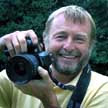
Following on from the posts of Ken Terry's beautiful wildlife shots of squirrels and red kites, I had a comment from Dorcas, who asked if there is a technique to using Servo Autofocus, or whether it is just a case of practice to get the best shots.
As I am not a Canon man, I thought the best person to answer the question would be the man who actually took the pictures, so I asked Ken for his response. Ken says...
"Canon's terminology is actually AI Servo. Different cameras have different terminology and different characteristics, so it is important to know the characteristics of your camera. Canon's 1D MKIII can be programmed using custom settings for individual use. For example the settings for a wildlife photographer would be different from a sports photographer. I only had the camera just over a week when I took the shots of the kite so I'm still learning the camera's capabilities.
The basic technique for using AI Servo is to pan the subject keeping the Autofocus point in the viewfinder on the subject. Again this autofocus point varies from camera to camera and in the case of the 1D MKIII this can be expanded and assist points can also help. This is part of programming the camera to your individual needs.
If you practice to start with on subjects that move in one direction at a steady speed such as a car it helps to get a feel of what is needed. The problem (and the fun) of photographing moving wildlife is that you never know what direction they will turn next. This is especially true of birds that can travel quickly up and down as well from side to side.
So to sum it up, you need to know your camera, you need to practice panning on steadily moving subjects to get a feel for it and finally practice on the wildlife.
I missed loads of shots while photographing the kites as I would just gain focus and then they would dive."
So there you go - straight from the man himself. Hope that helps.
Thanks Ken.
13 Mar 2008
Photographing with Autofocus mode


11 Mar 2008
Wildlife photography
 Ken Terry, one of my regular students for some years - and now a good friend - wanted to tackle some wildlife photography before he spent the weekend with my group learning more about portraiture in the comfort of the Cally Palace Hotel.
Ken owns some pretty neat kit and the three wonderful photographs here show that he really knows how to handle it.
I arranged for him to spend a day with Wildlife Ranger Keith Kirk, who knows the area and its wildlife extremely well. Keith took Ken to a secret location to photograph red squirrels and then, despite the cold and rain in the afternoon, Ken got an opportunity to photograph the spectacular red kites, which have been part of a successful re-introduction program here in SW Scotland.
Ken captured some great shots of both the squirrels and the red Kites, and I thank him for permission to post them on the blog. Wonderful photographs Ken. Very well done.
Equipment used: Canon 1D MkIII, Canon 500 mm LIS f4 lens mounted on a Manfrotto 055PROB tripod fitted with a Wimberley version II head. Ken used ISO 1000 and AV as the light was changing so quickly that sometimes it was 1/500 and sometimes 1/4000. It was windy and raining, but the cloud thickness varied.
This is how Ken set up the camera for each shot...
The top picture of the red kite:
AV, f5.0, 1/4000 sec, ISO 1000, Servo AF.
Lower picture of the red kite with its talons in the other bird's tail feathers:
AV, f5.6, 1/1600 sec, ISO 1000, Servo AF
The squirrel, below:
AV, f5.6, 1/320 sec, ISO 800, Single shot AF?