Showing posts with label Scotland. Show all posts

2 Sept 2008

Wildlife photography - spoonbills

I was out on the River Dee near my home the other day with wildlife ranger and photographer Keith Kirk. Some of my students will know Keith because I sometimes arrange for them to spend the day shooting wildlife with him.

The reason for our river trip was something very special – indeed it is a First for Scotland. Here in Kirkcudbright it has been known for some months that a pair of spoonbills have been feeding on the mud banks of the river. Well, it is now confirmed that the birds have successfully raised three chicks nearby. All five birds are now seen regularly feeding in the shallows.

This is an extremely rare and important event for wildlife in Britain. Although there is one instance of spoonbills having bred successfully in England, it is the first time in over 300 years that they have bred as far north as SW Scotland. Twitchers are now flocking to Kirkcudbright to see the spoonbills and, happily, the birds seem quite oblivious to their new fame.

Keith was shooting with his Nikon D300 and a 500mm Sigma lens. Due to the shallow water over the mud banks we were unable to get the boat very close, and Keith’s biggest difficulty was in keeping the camera still with the slow shutter speeds needed in the very low light. Although he pushed the ISO right up to 1600, and opened the aperture as wide as possible, he was still using a shutter speed of just 125sec. The motion of the boat and the movement of the birds did not help.

But just look at the picture Keith achieved – you can even see the rain spot bouncing off the wet mud.
If you would like to spend a day with Keith photographing wildlife in Galloway, Scotland, just contact me and I'll see if it can be arranged.

Top photograph by Keith Kirk
…and here’s one of the adult spoonbills striding past a resident heron. Under the conditions, that’s a great shot, Keith.

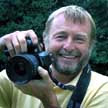
Lower photograph shows Keith at work photographing the spoonbills from the boat
Find out more about these rare birds on the RSPB site

16 Aug 2008

Video with Canon G9

You may be pleased - or maybe not - to know that my posts will again be getting more regular as I am now back home after my 'summer' sailing. I thought I might just give you one more blast of salt air by embedding a very short seafaring video here. It shows my boat Moonshadow rounding the notorious Mull of Galloway in SW Scotland. This headland can be a very nasty place to be in bad weather. On this trip there was little or no wind. Even so, the tide was whipping along and giving me a speed of 11.9 knots - that's a lot in a sailing boat.

The video was shot on my Canon G9 and, even considering the loss of quality of YouTube compression, it has done a pretty good job.

You will notice that some filming techniques are exactly the same as those used for stills photography. Towards the end, notice the slight lowering of the shooting angle in order to get a clearer view of the distant headland between the gear on the back of the boat. This is followed by zooming back to view the wider scene including the foreground - with stills photography, the shutter button would have been pressed to take a picture at each separate stage.


And for those of you who love shooting sunsets - the video finishes with a really spectacular one. We carried on sailing into the night.

30 Jun 2008

Light opportunities

The weather can be a bit fickle in Scotland - and that's being kind.

Light can change dramatically and suddenly. This can be both good and bad for photography because while this changable light can certainly add drama to your pictures, it does mean you must always make the most of your opportunities when they present themselves.

If ever there was an example of taking your photographs when you have perfect light, here it is. I took this very short video while my boat was on a mooring off the beautiful Scottish island of Arran. The low evening light was just magical and I took lots of pictures of the small town of Lamlash with the spectacular mountains of Arran in the background.

But just look what the weather was doing early next morning...

Enjoy the video - and remember, never expect beautiful light to last - press the button now!

25 Jun 2008

Photographing outdoor events

It's the time of year for open-air events like local carnivals, gymkhanas and town festivals. You really should try to get along to these weekend events. For one thing, they can be a great day out, but most of all, they offer tremendous photo opportunities if you keep your eyes open and your camera at the ready.

If you are at all nervous about photographing people, then these local events can be great places to get started. The folks who go along to them, both participants and spectators are usually there to enjoy themselves. Certainly the participants expect to be photographed, so you will have no trouble from that direction. The atmosphere will be relaxed and that always helps.

I photographed these two chaps taking part in a mediaeval battle re-enactment in my home town of Kirkcudbright in SW Scotland. The armies went at it hammer and tongue, knocking seven bells out of each other with swords and maces. All this made wonderful action photographs of course, but the shot I liked most was of these two 'dead' lying on the battlefield. I like the way the man nearest the camera is holding his chest as if he's having palpitations, while the other chap has two mighty swords stuck in his chest.

Of course this sort of event can lend itself readily to the photo-essay treatment, with pictures of the soldiers putting on their armour, sharpening swords, fighting, and maybe even in the bar having a pint between bouts. You should always be on the lookout for the unusual, out-of-context shot. Perhaps an armoured soldier eating an ice cream, sitting in his car, or checking his watch.

Just a couple of tips...

Try to use a reasonably fast shutter speed to freeze the action - no less than 1/250sec if possible.

A small telephoto lens is often ideal for this sort of assignment - something equivalent to around 125mm

Whatever you do go and have a great day out and take lots of photographs.

19 Jun 2008

Photography at sea

The other day I said that I would be posting some of the pictures from my time aboard my boat.
Well, this one captures one of those very special moments when the light is just mind-blowing. I was sailing up Loch Striven in Scotland when the skies went almost jet black as a squall came in. Then, suddenly, the cloud parted just wide enough to allow a beam of sun to spotlight the side of the hil and that lonely cottage down on the shore.

Oh, just in case my friend Alwyn, who suggested last time I posted a picture of this sort that I'd got at it a bit with Photoshop, no Alwyn, this is as nature produced it. In fact, Alwyn had a point last time, I had just tweaked the image a little, but not his time.

It is vital not to underexpose in these conditions. Expose for those highlights and let the rest go almost black if it wants too that brings out the drama. That's what the picture is all about.

The pilot book decsribes this Scottish loch as 'bleak and featureless', but I have to disagree when the light plays tricks like this. Daunting, awesome and threatening, maybe, but featureless, no.

One of the downsides of taking photographs of seascapes and landscapes from a boat is that the images can often take on a two-dimensional, flat aspect because of the lack of foreground interest. In some respects, this picture has to be described as lacking depth, but the drama of that light makes up for that in my opinion.

This picture will be one of a series that will illustrate a feature I have written for a yachting Magazine called Sailing Today I actually began the magazine myself some years ago and became its founding editor. I still write and photograph regular features for it when I have time.

6 Jun 2008

Photography in mixed light


For anyone who doesn't know, and who may have a passing interest, I'm a keen cruising sailor, and posts on the blog may be a little spasmodic during the summer months because of this interest. But that doesn't mean that I will not be taking lots photographs. In fact few activities lend themselves to picture gathering more readily than sailing. Maybe not when the conditions are rough; then I'm just too busy sailing the boat. However, cruising takes me to some very beautiful locations. At the moment I'm based on the West Coast of Scotland and few places on earth can be more spectacular. Mountains and sea are a powerful combination. I hope to be posting some pictures taken on some of my short voyages over the next few weeks… but I promise I won't bore you rigid with boat talk.


Yes, I'm lucky that on my boat I get to see some wonderful places; I often drop the hook in secluded anchorages that are impossible to get to without a boat. But, you know, with that understanding of the light that I keep rattling on about, visual interest and appeal is to be found just about everywhere you look.


The picture above confronted me one evening when I put my head out of the saloon doors and looked across the marina at Troon Yacht Haven. Now marinas are not noted for their beauty. In fact they have been disparagingly described as boat parks. Although Troon is a good safe place to keep a yacht, no one could describe its setting as idyllic. But look at the way the last rays of daylight are slanting onto the houses behind the row of boats, while the boats remain in shadow. I took one glance at this scene and dived back below to get the camera. This sort of light sometimes last for only a few seconds.


It's the combination of light temperatures the 'mixed' light - that gives this picture impact and appeal. The high temperature blue light of the shadows is in total contrast to the low temperature golden light shining on the houses. Those are not the prettiest houses in the world, but in that wonderful light the place looks like heaven.


It is vital not to over-expose with this type of shot. By all means let the shadows go dark that will add to the impact but over-exposure would have washed out and lost the colour in the houses. I took my light reading from the houses NOT the boats, and I deliberately under-exposed by 1/3 stop in order to saturate the colours a little.

3 Jun 2008

photographing Scotland to Australia

Here in Kirkcudbright early this year one of the students who joined us for a photography weekend was Tee Smith. Tee, who was then based in London, was keen to learn more about travel photography because he was about to set off on an epic trip to Australia via the trans-Siberian Express and Vietnam.

Tee was born in Thailand and educated in New Zealand, so his first trip to Scotland was quite an experience for him. Especially as his weekend here coincided with Burns Night. Now, I'm not a Scot, but there were plenty of Scottish photographers on the weekend who explained the mysteries of 'addressing the haggis' and the wonders of clewty dumplings. To his eternal credit, Tee tried and enjoyed all this wholesome Scottish food - as we all did. Well, you simply have to on Burns Night. I think Tee even tried a 'wee dram'.

All was quiet from Tee until yesterday when I got an email from him to say he had finally arrived in Australia after a wonderful trip and after taking hundreds of photographs.

He sent me a link to some of them and it's well worth taking a look. There are some beautiful evocative photographs among the usual - and very important - fun travel pictures that can mean so much.

I have posted a couple of them here for you to enjoy, but do take a look at the others.
The top photograph shows just how important it is to keep that camera handy at all times - here Tee has been snapping away even while riding through Hanoi on a cyclo.

The middle picture is a poingnant shot of a woman placing a lighted candle on the memorial of the Jewish Ghetto in Warsaw - the scene of some of the worst German atrocities in WW2.

The lower picture shows the man himself - Tee tucking into a meal in Vietnam.
The links to Tee's Facebook pages are:

5 Mar 2008

Photographing shadows and highlights


Photograph by Peter Frisby

I've had a great couple of days here in SW Scotland with Peter Frisby from Staffordshire. Peter came to me for some one-to-one tuition. The weather was beautiful and I took him to my favourite hidden cove down on the sea shore on the first day. The light was really spectacular with a pastel blue sky and lots of dramatic clouds. Absolutely ideal for landscape and seascape photography.

Despite the fact that Peter has been taking photographs for only a very short time, he has done a great deal of reading on the subject, so he had a reasonable grasp of the fundaments of exposure.

One of the things that was confusing him was the situation in which a landscape might have a foreground in shadow and a background brightly lit. I explained that there were several methods of dealing with this very common and quite difficult situation. The photographer is faced with a choice of (A) exposing for the shaded area - so allowing the bright background to become over-exposed and 'burnt-out'. This always looks dreadful. (B) Exposing for the brighter area of the picture and allowing the shaded area to go dark. (C) Compromise and interpolate the exposure between the two extremes - rarely very successful. Most frequently (B) is the best.

In the real world, you have several options open to you to combat the problem.

1 - Use a gradual grey filter to darken the bright background in the upper section of the picture.

2 - Put the camera on a tripod and take two shots from precisely the same angle. One exposing for the shadows and one exposing for the highlights. These can then easily be put together in Photoshop using the Layers Mask. This is a highly effective and probably the best way of doing the job.

3 - Expose for the highlights and - if the foreground is not totally black - subtley lift some detail back into this area using Photoshop's Dodge Tool facility. I work on the principle that an under-exposed area of an image can be lightened to reveal detail, while an overexposed, burnt-out, area is just about hopeless.

Peter has not yet got to grips with Photoshop, so when he spotted the photographed the scene above, we had an ideal oportunity to demonstrate option 3. He exposed for the brightly lit far distance, and allowed the foreground to go dark. Once opened in Photoshop when we got back to base, we simply selected the 'Dodge' tool with a large brush at about 8% transparency to lighten the highlights. Several passes were made over the foreground to achieve the results shown. I don't have Peter's original to show you, but I can assue you that foreground really was very dark indeed.

Now just in case you are tempted to get all 'precious' and sniffy about 'manipulating' an image in this way, just remember that those icons for the 'Burn' and the 'Dodge' tool come straight from the darkroom. The 'Dodge' icon represents the bit of round card we used to cut out and stick to a short length of stiff wire. Photographic printers would jiggle this 'dodger' about over over a dark area of the print during exposure in the enlarger. The effect was to lighten that area. The 'Burn' icon is a representation of the printer's hand making a hole through which he would direct extra light to a particlular portion of the print in order to darken it. So, you see - there's nothing new about Photoshop - the Victorians were using the same ideas over 100 years ago.


Peter (that's him above at work in Kirkcudbright Harbour) was using an Olympus E-510 and I have to say I was very taken by it. It handles very well indeed and I was impressed by the results. Peter's shot of the shells (below) is needle sharp.

29 Feb 2008

Learning how to take better photographs

Just thought you might like to watch a short video I put up on You Tube a short while back. I had a lot of fun filming it and putting it together with the help of two lovely guys - Graham and Malcolm. They came up here to SW Scotland for a couple of day's tuition and we had a great time.

It's always a joy for me to show my students some of the hidden parts of Galloway, one of the most beautiful places in Scotland. We spent time photographing some old, wrecked boats, we went down to one of my favourite coves and tried out long exposures to photograph a secret waterfall.

Anyway - enjoy, and thanks again, Graham and Malcolm.