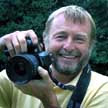
I'm hoping to get along to the Focus on Imaging Exhibition at the NEC in Birmingham tomorrow. It would be great to meet some of you if you happen to be there. I'll be wearing a white tee-shirt with the address of my website on the back...
www.photoactive.co.uk
So if you happen to see me - do say hello.
25 Feb 2008
Focus on Imaging NEC


24 Feb 2008
How to photograph abstracts - part 2

Pablo Picasso, arguably the greatest abstract painter of all time, spent years learning the craft of fine draughtsmanship before he created his unique abstract art. The moral of the story?... learn the rules before you go and break 'em
So here are just ten practical ways to get more from abstract photography...
Practical camera skills will lead to better abstract photographs.
Look more closely at everyday subjects.
Look for strong colour, lines, shapes and textures.
Shadows can be included to create abstract shapes.
Place your rectangle around the most interesting part of the subject.
Try to exclude any obviously recognisable elements.
Create visual puzzles to make your viewer think.
Don't always tilt your camera at an angle this is a hackneyed, overused idea.
Look closely at the natural world to see beautiful abstracts.
Think about presenting a finished set of abstract photographs as a montage.
Photograph above:
So what is it? This type of puzzling photograph doesn't actually need and answer. For me it is enough to enjoy the diagonal bands of colour and the shapes created by the shadows. If you really want to know, it is a picture of upturned canoes
22 Feb 2008
Photography Weekend place available
Due to a late cancellation I now have one place available for the Photography Weekend on 7th - 9th March. The theme is portraiture with both available light and flash.
Full details on my website
You'll really enjoy this one, but do let me know asap.
How to photograph abstracts - part 1

Let your imagination off the leash and photography becomes far more than a means of capturing the literal world however beautifully or skilfully that may be done. Once you start to look beyond obvious reality, a whole new world of shape, colour and form begins to reveal itself. Capturing and portraying abstract design is not just the preserve of painters who have it easy because they can paint what is inside their heads and claim the result to be art. The photographer needs an actual subject, and must think objectively before he, or she, can convey a subjective view of it. Practical skills and visual perception are needed in equal doses to release a subject's full potential.
Of course, you must look further than a simple representation of the obvious world, but unless you just get lucky, those basic practical photographic skills are essential before worthwhile abstract pictures can be produced with certainty almost every time.
And that is where many newcomers to photography come unstuck and need help. The 'abstract' genre is so often an excuse for poor, lack-lustre 'arty' images. It is also where I part company with the teaching methods in many colleges and universities these days. I have lost count of the number of youngsters who have come to me straight from college and told me they only like taking 'abstract shots'. Why? Because they don't know how to photograph anything else. They have not been taught the essential practical skills of photography that will enable them to be fully creative. They have been sent out unprepared and told to 'be creative' as if this by itself will produce 'art'. What utter nonsense. The methods encouraged vary from waving the camera about with a slow shutter speed to angling every composition at 45 degrees. These half-baked teaching methods are cheating our youngsters; filling them with false hopes and denying them access to professional standards though which they might find employment and personal fulfillment.
To me, an abstract picture is one that draws on the less obvious elements of a scene or object such as line, shape, texture, tone and colour purely for their own sake. Often it is the type of image that stretches the imagination of the viewer that is most successful. A picture that puzzles or intrigues; the one that makes someone look twice and then hold their attention.
Start by looking at an everyday subject it might be an interesting modern building or perhaps a river view with reflections. Look for lines, shapes, colour, anything that you can identify as having some visual appeal. Then frame these elements of the subject carefully, placing your rectangle around them tightly so that you isolate them into one strong composition.
The joy of seeking abstract images is that everyone sees things quite differently, in fact some photographers just cannot see them at all and prefer to concentrate on more obvious subjects. It's all subjective and in each individual's eye. Once you start to see abstract pictures, though, you will soon realise that they can be found everywhere in the natural world and in the everyday manmade world as well. So far as my pictures here are concerned, they were all taken purely for the fun of capturing them, and they make no claim to be art… and if I can spot the visual potential of simple subjects like these then so can you.
One of the best ways to start recognising the abstract potential of a subject is to take a closer look at an everyday subject. Try to home in on one particular area of the whole. Find something that has strong colour, good lines or outstanding shapes. Don't fall into the trap of tilting the camera to one side every time in an attempt to inject an unusual angle or viewpoint. This is a hackneyed idea. Try, instead, to compose tightly and if possible crop out any obviously recognisable elements.
Photograph above:
I found this fairground a fertile ground for all sorts of abstract pictures. It was closed during the daytime and the canvas covers of some of the rides have helped provide an intriguing point of view. I like the bright colours and the fact that the clown's picture can only be half seen
20 Feb 2008
Photography in bars and cafes

Not counting India, which is in a league of its own, there are three places in the world that really press my button - places where you can almost feel the buzz and vitality coming up through the pavements beneath your feet. The first is New York, then Hong Kong. The third, and possibly my favourite, is Istanbul.
How could any photographer go to Istanbul and not find visual stimulation? The buildings,the skyline, the boats on the Bosphorus, the markets. But, for me, best of all the people. I have always found the people of Turkey to be kind and helpful.
The picture above shows a man smoking his hookah, better known in the West as a hubble-bubble - in a cafe on the old Galatta Bridge. It was taken before this fascinating bridge with its double-deck of shops and cafes was burned down. Probably by someone sat in a cafe smoking a hookah.
I just walked into this cafe because it looked interesting, and ordered a glass of that wonderful Turkish coffee that is so strong and thick you can stand a spoon up in it. Within a short time, people were asking where I was from, introducing themselves and trying to speak English.
Now you must judge these situations very carefully when you are in a strange new place, but all my senses told me there was nothing to fear in this cafe. I started to take photographs and some of the customers insisted that I took pictures of them. One man borrowed my camera to photograph me with the owners of the cafe. I was even prevailed upon to take a pull on a hookah which damned near killed me. I still have that out-of-focus shot as a happy memento.
The photograph from the cafe that pleased me most was of the man sat quiety puffing away on his hookah beneath the faded pictures on the wall.
The picture was taken with a Nikon F3 with a 24mm Nikkor lens. It was hand held ISO 400 Neopan film at 1/20sec at f3.5
18 Feb 2008
How to use a telephoto lens

Here is another simple example of using a small telephoto lens - in the case a 135mm equivalent - to capture candid pictures of people. I've had some photographers take me to task for daring to use a telephoto for 'street' photography. These purists believe it is only possible to take real 'street' pictures if a lens of 35-50mm is used. They are talking twaddle.
Perhaps they are secretly obsessed by the notion that they are following the example of Henri Cartier-Bresson who, they believe, was able to make himself invisible, get in close to all his subjects without being seen, and capture them all on a Leica with just a 35mm lens.
The story goes that the 'great' Cartier-Bresson tried this method while covering Winston Churchill's funeral for The Sunday Times. Apparently he did not produce a single photograph worth printing.
A small telephoto can actually add a lot to the 'feel' of a candid photograph by throwing the background slightly out of focus and isolating the most important elements of the picture. This frees the viewer's eye to concentrate on what really matters in the picture.
Of course it also gives the photographer the added advantage of remaining just that little bit less obvious.
16 Feb 2008
Photography weekend now fully booked

The Photography Weekend at the Cally Palace Hotel, March 7-9th is now fully booked. I will not be able to change the Photoactive website for a little while so thought it best to let everyone know through the blog.
Meanwhile, never missing a chance to publish a a photograph or two, I've posted a couple more pictures taken on that little outing with the Canon G9 yesterday. I was in the old city of Chester a wonderful place to be taking photographs.
I  loved the old chair, and confess that when I spotted it I did move it to a positition in front of that lovely distressed wood. What a great background. Remember, the world is your studio - so never be afraid to move things around a little if you think it's going to make a better picture - as a travel photographer I often did exactly that. No one will mind if you put things back where you found them.
The other photograph was taken in Chester Cathedral. Dead simple, nothing clever, I was just attracted to the colours hitting the wall from the light coming through one of the stained glass windows.
Canon G9 optical viewfinder

I got a few minutes to get out and about with that new Canon G9 of mine yesterday. The first thing I wanted to do was put that optical viewfinder to the test after my initial misgivings. I found a very simply subject that was not moving, and tried to compose the same picture by using first the lcd screen and then the optical viewfinder. I readily admit that this was not a scientific test and it should have been done on a tripod - but my findings definitely confirmed my fears - that optical viewfinder is rubbish.
It does not point at the same framing as the screen by a very long way.
Quite apart from the fact that its coverage is only a fraction of the lcd, anyone using this optical viewfnder will almost certainly cut off a goodly section of the bottom of the picture. It is just simply dreadful and almost useless.
I was seriously impressed by the Image Stabalization function - that really does work very well. The pictures you see here were shot hand-held at 1/20sec and there is not a hint of camera shake even though I was zoomed in a fair bit.
The top photograh was composed with the rear lcd and the bottom one with the optical viewfinder. I did not cheat, but tried really hard to compose both pictures properly.
Subscribe to:
Posts (Atom)